Window cleaning marketing
How much should a window cleaning business spend on Facebook ads?
By Ronan O'Doherty · Updated
There is no single daily budget that fits every window cleaner. Start with what a completed job leaves after labor, supplies and travel, how many extra jobs you can handle, and an amount you can afford to lose while testing. Then judge advertising by qualified inquiries and paid jobs, not just inexpensive messages.
A real campaign, not a universal budget recommendation
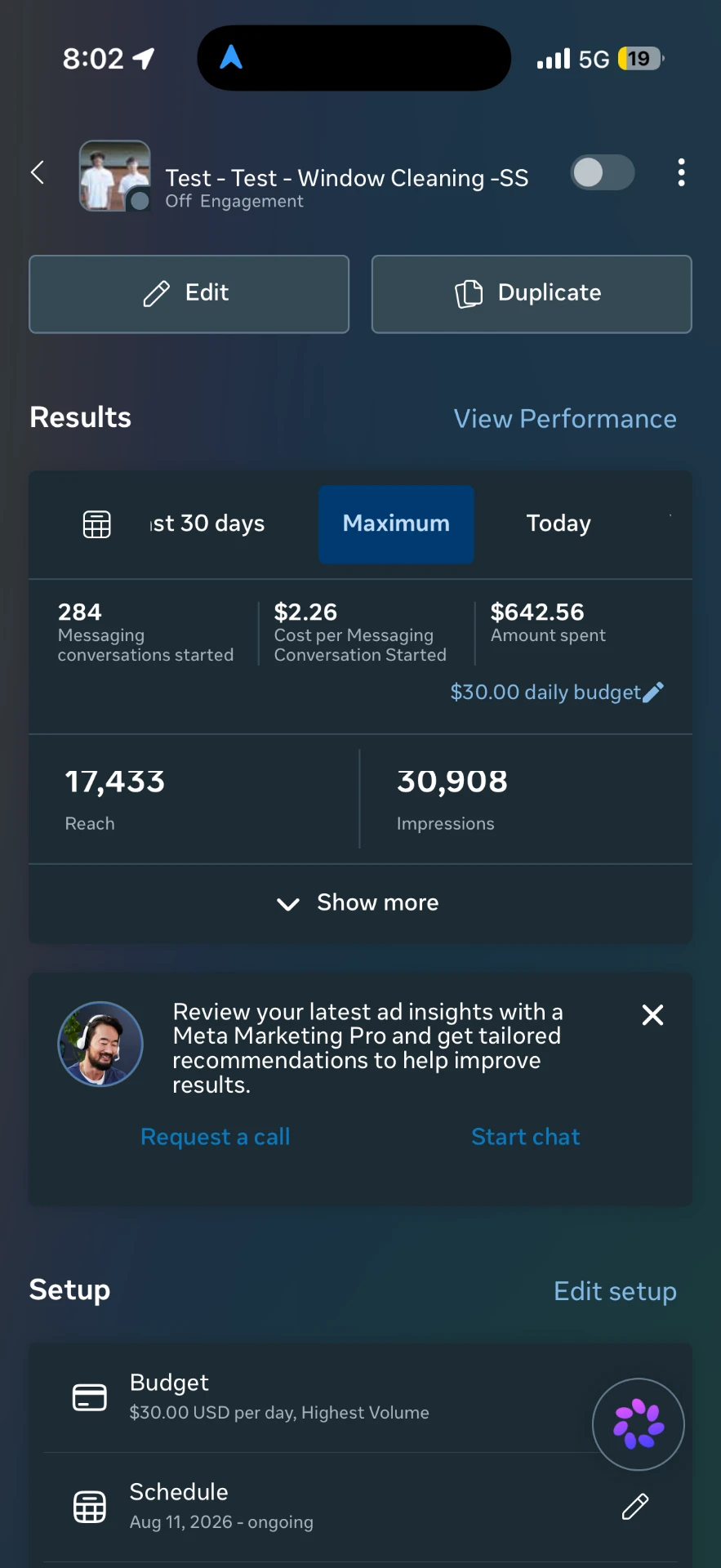
- Amount spent
- $642.56
- Conversations
- 284
- Per conversation
- $2.26
The screenshot shows a $30 daily budget setting. Total recorded spend was $642.56, with 284 messaging conversations: $642.56 ÷ 284 = about $2.26 per conversation. A daily setting is not proof of a month's spend, and this screenshot does not establish the complete campaign duration. Do not project these results onto every market or future campaign.
The owner separately reported 5x ROAS. That is an owner-reported claim, not independently verified revenue. Our full Squeaky Scholars case study distinguishes screenshot metrics from the revenue implied by that return. A conversation can be a quote request, an unsuitable inquiry or a repeat contact; it is not automatically a new paying customer.
Separate the advertising budget from the full cost
Ad spend pays Meta for placements on Facebook and Instagram. Agency management, creative production, website work and any booking software are separate costs. Ask for each line in the proposal rather than treating a quoted management fee as money that will all reach the ad platform. LTRmarketing scopes management separately; we do not publish a fixed fee or promise a particular return.
As a planning illustration, $30 a day for 30 days would be $900 in ad spend before fees. That multiplication is not Squeaky Scholars' reported monthly spend and is not our recommended minimum. Choose a capped test total based on your business, and agree who checks delivery and stops the test if it exceeds the amount you can risk.
Work backward from a profitable completed job
Write down your average collected payment, then subtract direct labor, supplies, travel and other job costs. The amount left is a starting point for assessing acquisition cost, not guaranteed take-home profit. Fixed overhead and management fees still need to be covered. A $120 job value in our case study is an owner-supplied approximation, not your price and not $120 of profit.
Compare total ad spend with the number of jobs actually booked and paid from those ads. For a fuller acquisition-cost view, include management and creative expenses too. If recurring customers are part of your business, track their real repeat purchases before assigning future value. A hoped-for recurring booking should not make an unprofitable first job look profitable on paper.
Prepare the inquiry path before spending
Show genuine photos or video of your cleaning work, describe the service clearly and target the area you can realistically cover. Ask enough to quote accurately, such as property type, location and access, without turning the first reply into a long questionnaire. Avoid a flat-price offer unless it genuinely fits the work and you can explain its limits.
Assign someone to answer messages while your team is working. Track the source, suitability, quote, booking and collected payment for each inquiry. If messages arrive but jobs do not, check response time, quote clarity and availability before increasing the budget. Cheap conversations are not a reason to scale when the business cannot serve them profitably.
When should you increase or pause the budget?
Increase spending only after the outcomes justify it and you have room in the schedule. Review enough completed outcomes to understand lead quality; a few early messages can be misleading. Keep a record of what changed so you can distinguish a new offer or creative test from a budget change. There is no promised learning period or universal scale-up percentage.
Pause and investigate if the destination is broken, inquiries are mostly outside your area, responses are not being handled or the agreed test cap is reached. Fix the bottleneck before paying for more traffic. Keep customer details private when sharing reports, and give your agency outcome feedback without publishing personal lead information.
Bring your own numbers to a strategy call
Bring your average job value, service area, schedule capacity, current offer and any past advertising results. We can discuss the inquiry destination, follow-up process, test scope and separate management costs. Our Facebook and Instagram ads management service supports window-cleaning businesses nationwide; Portland is our base, not a limit on who we serve.
For broader preparation, read the service-business Facebook ads checklist. The next useful step is a test your business can measure and afford, not copying another company's spend or expecting its results.