Facebook and Instagram ads guide
Before you run Facebook ads: a checklist for service businesses
By Ronan O'Doherty · Published · Updated
Many business owners try Facebook ads, spend money, and are left wondering where it went. Usually the ads were not the only problem. This checklist covers what to have ready before you spend, so your budget turns into conversations and booked jobs.
1. A clear offer people already want
Ads amplify an offer; they rarely fix a weak one. Before spending, write one sentence that says what you do, who it is for and why someone should reach out now. If friends and past customers cannot repeat it back, the ad will struggle too.
2. One simple way to respond
Pick a single action: send a message, call, or fill in a short form. Every extra field or step loses people. For many local service businesses, messaging campaigns work well because the customer can ask a question without committing.
3. Someone ready to answer fast
A lead that waits hours often goes cold or books with someone else. Decide who answers messages, how quickly, and what they say first. Have prices or a quote process ready so conversations turn into booked jobs.
4. A way to know which ads made money
Meta reports clicks and conversations, not sales. Keep a simple record of which leads came from ads and which ones paid. Without it, you cannot tell a good campaign from an expensive one.
5. A test budget you can afford to learn with
Start with an amount you are comfortable spending to learn, run it long enough to gather real conversations, then decide. Remember that ad spend is paid to Meta and is separate from any agency management fee.
6. Creative that looks like your business
Real photos of your work, your team and your results usually feel more trustworthy than generic stock images. Show the before and after, the finished job, or the problem you solve.
Choose an inquiry destination before choosing creative
A detailing customer may need to explain the vehicle and service they want. A window-cleaning customer may need a quote based on property size and access. Neither inquiry is automatically a booked job. Decide what information your team needs to assess fit, then choose a message conversation, phone call or form that can collect it without unnecessary friction.
If you send people to a website, the page should repeat the service and offer in the ad, show relevant work and make contact easy on a phone. Test the destination yourself: open the ad link, read the offer and complete the inquiry. A campaign should not pay to send potential customers to a broken form or a page that promises a different service.
Build a budget around customer economics
For a campaign-specific example, read how to plan a window-cleaning Facebook ads budget, using Squeaky Scholars' screenshot results.
Start with the approximate value of a completed job, then consider labor, materials, travel and other costs. Revenue is not profit, and a high advertising return can still leave little margin. Keep agency management fees and creative costs separate from the amount spent buying placements on Meta so you can see the full cost of acquiring work.
For example, the owner supplied approximate job values of $200 for detailing and $120 for window cleaning in our case studies. Those assumptions help explain the calculations, but they are not prices for your business. Use your own average completed-job value and costs. An affordable test for one company can be too large or too small for another.
Keep a lead log that connects conversations to jobs
Record the inquiry source, service requested, whether the customer was a good fit, whether a quote was given and whether a job was booked and paid. Record collected revenue rather than counting every quote as a sale. Avoid putting personal customer details into public reports; the agency needs enough outcome feedback to assess quality, not an unrestricted copy of your customer records.
Compare ad spend with conversations first, then review qualified inquiries, bookings and collected revenue. ROAS means attributed revenue divided by ad spend. It does not deduct management fees or operating costs, and it is only as reliable as the revenue attribution behind it. In our published campaigns, screenshot conversations and separately reported ROAS are different types of evidence; reverse-calculated revenue remains implied, not verified.
Test a clear hypothesis, not everything at once
Write down what you want to learn before changing a campaign. A useful question might be whether a photo of finished work produces better-fit inquiries than a service demonstration. Keep the offer and destination consistent where practical so the result is interpretable. With a small number of leads, differences can be chance rather than a reliable winner.
When reviewing results, check the entire path. Irrelevant messages suggest an audience or offer problem; good-fit messages without bookings suggest quote, availability or follow-up friction. Do not increase spend just because clicks are inexpensive. Discuss the quality of the work generated, the capacity to serve it and what needs to change next.
What to ask an ads agency before hiring
Ask who supplies photos and video, which campaign work is included, how results will be reported and who responds to leads. Confirm account access and the separate platform budget. Ask the agency to explain a relevant example, including what the platform actually measured and what the business reported afterward. A service-business messaging campaign is not proof of e-commerce purchases or Google Ads performance.
Bring your priority service, customer area, approximate job value, current website and any existing advertising data to the first conversation. Our Facebook and Instagram ads management page explains our scope and process. There is no guaranteed ROAS or fixed budget that fits every business; the useful outcome of the call is a clear next step and an agreed scope.
Why Facebook ads get clicks but no customers
- Clicks but no messages
- The landing page or offer does not match the ad, or asks for too much too soon.
- Messages but no bookings
- Slow replies, no clear price or next step, or the audience is too broad.
- Cheap leads that never buy
- The ad attracts curiosity instead of buyers. Tighten who you target and what you promise.
- Results you cannot explain
- No record connecting leads to paid jobs, so it is impossible to know what worked.
What this looked like for two real campaigns
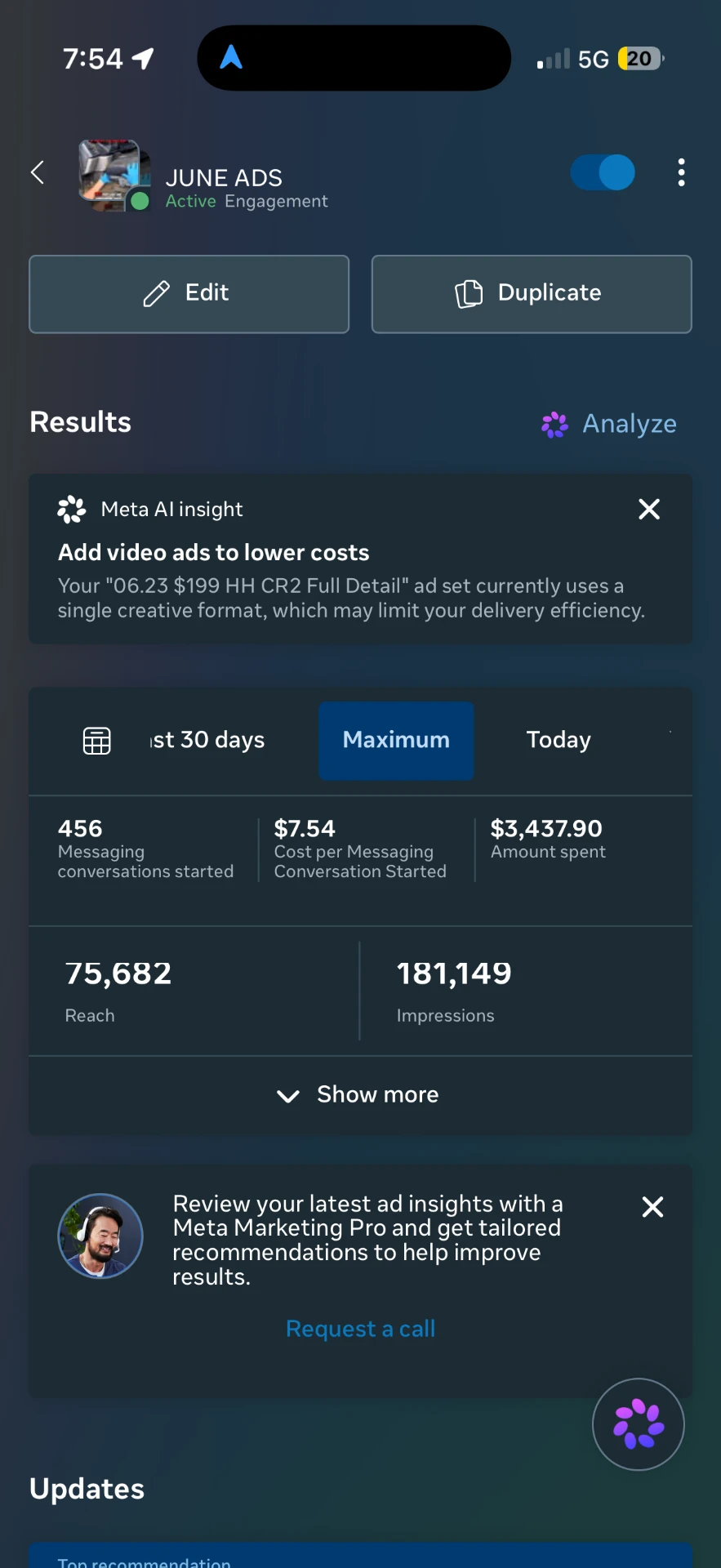
- ClearviewDNW (auto detailing): about $3,438 in ad spend started 456 messaging conversations. The owner reported a 10x return, which implies about $34,379 in revenue.
- Squeaky Scholars (window cleaning): about $643 in ad spend started 284 messaging conversations. The owner reported a 5x return, which implies about $3,213 in revenue.
Returns are owner-reported and not independently verified. See the full screenshots and math on the case studies page.
Want a second set of eyes?
We manage Facebook and Instagram ads for service businesses nationwide. On a free strategy call we will look at your offer, follow-up and budget and tell you honestly whether ads make sense yet. Learn more about our ad management services.